
 Send Email
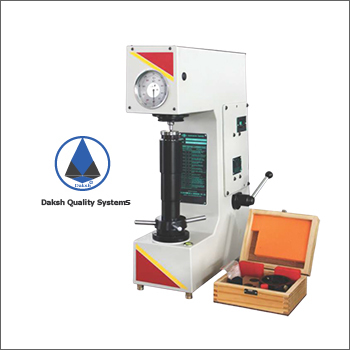
Advanced Digital Rockwell Hardness Tester
165000 INR/Piece
Product Details:
- Port Size Standard RS232 interface
- Frequency 50/60 Hz
- Accuracy 1.0 HR
- Number of Specimens Multiple/Batch or Single Specimen
- Test Range HRA, HRB, HRC, HRD, HRE, HRF, HRG, HRH, HRK, HRL, HRM, HRP, HRS, HRV, HR30T, HR15T, HR45T, HR30N, HR15N, HR45N, HR30W, HR15W, HR45W
- Max Height 170 mm
- Temperature 10C ~ 35C
- Click to view more
X
Advanced Digital Rockwell Hardness Tester Price And Quantity
- 165000 INR/Piece
- 1 Piece
Advanced Digital Rockwell Hardness Tester Product Specifications
- Immediate (digital display update)
- 0.1 HR
- AC 220 V 10%, 50/60 Hz
- 85% RH
- Fully Automatic
- Automatic loading/unloading, data storage, statistical analysis, conversion for Brinell & Vickers, error alarm
- Diameter: 2-70 mm, Height: 2-170 mm
- Advanced Digital Rockwell Hardness Tester
- Large digital LCD touchscreen
- 0.08 mm/sec
- Touch Screen Digital Control
- 20-95 HRA, 20-100 HRB, 20-70 HRC
- Hardness Testing of Metals
- Testing hardness of metals and alloys in workshops, laboratories, and quality control
- 50/60 Hz
- 1.0 HR
- Multiple/Batch or Single Specimen
- Standard RS232 interface
- 160 kg (Max sample weight)
- up to 145 mm
- RS232 Serial Port
- Approx. 80 kg
- Table Top
- 220V
- Rockwell (A, B, C, D, E, F, G, H, K, L, M, P, S, V, 15N/T/W, 30N/T/W, 45N/T/W)
- HRA, HRB, HRC, HRD, HRE, HRF, HRG, HRH, HRK, HRL, HRM, HRP, HRS, HRV, HR30T, HR15T, HR45T, HR30N, HR15N, HR45N, HR30W, HR15W, HR45W
- 170 mm
- 155 mm (max distance from indenter centre to instrument wall)
- 10C ~ 35C
- Meets ISO 6508, ASTM E18 standards
- 150 mm
- Overload protection, Power failure memory
- Integrated LED illumination
- USB, RS232, Printer
- Automatic & Manual
- 60, 100, 150 kgf (588, 980, 1471 N)
- Up to 500 test results
- Diamond cone and steel ball indenters
- <200 W
- One-button operation with programmable test cycles
- Heavy-duty cast iron
- Advanced Digital Rockwell Hardness Tester
- PC connectivity and statistical analysis software
Advanced Digital Rockwell Hardness Tester Trade Information
- 15 Piece Per Month
- 3-4 Days
Product Description
Product details
| Brand | TRH-150 DM |
| Depth of Throat | 148 mm |
| Dimensions | 580 X 270 X 915 mm Approx |
| Dwell Time | 1 to 99 seconds |
| Frequency | 50 Hz |
| Inits Loads | 10 Kgf |
| Least Count | 0.1 |
| Maximum Test Height | 295 mm |
| Phase | Single Phase |
| Test Loads | 60. 100, 150 Kgf |
| Voltage | 220 V |
| Model Name/Number | Advanced Digital Rockwell Hardness Tester TRH-150 DM |
Effortless Precision and Versatile Application
Engineered for reliable performance across a wide range of hardness tests, this digital Rockwell tester adapts to various specimen sizes and shapes. With its large sample table and batch or single testing modes, it's suited for metal workshops, laboratories, and quality control departments. Compatibility with multiple hardness scales ensures flexibility in operations.
Future-Ready Data Management and Connectivity
Seamless integration with modern production environments is enabled by extensive data output options: USB, RS232, onboard printer, and PC connectivity for statistical analysis software. Up to 500 results can be securely stored, ensuring compliance with inspection and traceability requirements. Built-in LED illumination enhances usability, even in low-light settings.
Advanced Safety and User-Centric Design
The tester features overload protection, automatic and manual calibration options, and intuitive touchscreen controls for simplified operation. With its heavy-duty cast iron body and energy-efficient design (<200 W), the device offers durability for continuous industrial use while maintaining precise results with 1.0 HR accuracy.
FAQ's of Advanced Digital Rockwell Hardness Tester:
Q: How do I operate the Advanced Digital Rockwell Hardness Tester for a hardness test?
A: To perform a test, place your specimen (diameter 2-70 mm, height 2-170 mm) on the sample table and select the appropriate indenter (diamond cone or steel ball). Using the touch screen, choose the test force and Rockwell scale needed, then initiate testing with the one-button operation. The machine will automatically apply the load, measure, and display the result on the large digital LCD screen.Q: What types of data output and storage options does the tester offer?
A: The tester allows you to store up to 500 test results internally. Data can be exported via USB, RS232 port, or directly to an onboard printer. Additionally, the machine supports PC connectivity and comes with statistical analysis software for in-depth review and reporting of hardness test outcomes.Q: When should I use the diamond cone or steel ball indenter for testing?
A: Choose the diamond cone indenter for harder metals and alloys, typically for scales like HRA and HRC. The steel ball indenter is suitable for softer materials, such as those requiring HRB or similar scales. Select the desired indenter based on your specimen material and the Rockwell scale to achieve accurate results.Q: Where can this hardness tester be effectively utilized?
A: This advanced digital Rockwell tester is ideal for metalworking workshops, laboratories, and industrial quality control environments. Its robust construction and flexible test capabilities support a wide array of applications across different metal and alloy types.Q: What is the calibration process for maintaining accuracy?
A: Calibration can be performed either automatically or manually using standard Rockwell test blocks. The instrument's calibration mode guides users through each step on the touch display, ensuring compliance with ISO 6508 and ASTM E18 standards and maintaining accuracy within 1.0 HR.Q: How does the tester protect against operational issues like power outages or overloads?
A: Equipped with overload protection, the device prevents internal damage during overloading. In the event of a power failure, its built-in memory retains previous settings and measurements, allowing you to resume testing seamlessly once power is restored.Q: What are the main benefits of using this advanced Rockwell hardness tester?
A: Key benefits include fully automatic one-button operation, support for a broad range of Rockwell scales, immediate digital display of results, programmable test cycles, and extensive connectivity for data and statistical analysis. These features enhance productivity, improve accuracy, and simplify documentation in quality assurance workflows.Tell us about your requirement

Price:
Quantity
Select Unit
- 50
- 100
- 200
- 250
- 500
- 1000+
Additional detail
Mobile number
Email

Other Products in 'Rockwell Hardness Tester' category

Contact Details

- "Daksh Bhawan", 12 Sector-b, Shiv Dham Behind Queens College, Khandwa Road, Indore - 452017, Madhya Pradesh, India
- Phone : 08045814517
DAKSH QUALITY SYSTEMS
COMPLETE MICROSCOPY SOLUTIONS

- Mr Naresh Sihag (C.E.O.)
- Mobile : 08045814517
- Send Inquiry
 Send Inquiry
 Send Inquiry
 Send SMS
 Call Me Free
DAKSH QUALITY SYSTEM
All Rights Reserved.(Terms of Use)
Developed and Managed by Infocom Network Private Limited.
Developed and Managed by Infocom Network Private Limited.
